Across 98,754 older adults, sarcopenia was associated with a 1.93-fold higher risk of falls, 2.25-fold for fractures, 2.74-fold for disability and 2.09-fold for death (Su et al., J Clin Med 2022). Sarcopenia-related hospitalisation costs in the US have been estimated at 40.4 billion USD (Goates et al., 2019). There is still no approved drug.
Not for lack of investment. Agents that reliably increased lean mass, bimagrumab and landogrozumab among them, failed to improve what patients actually experience: strength, gait speed, rising from a chair. The field’s own conclusion is an uncoupling of mass gain from functional gain.
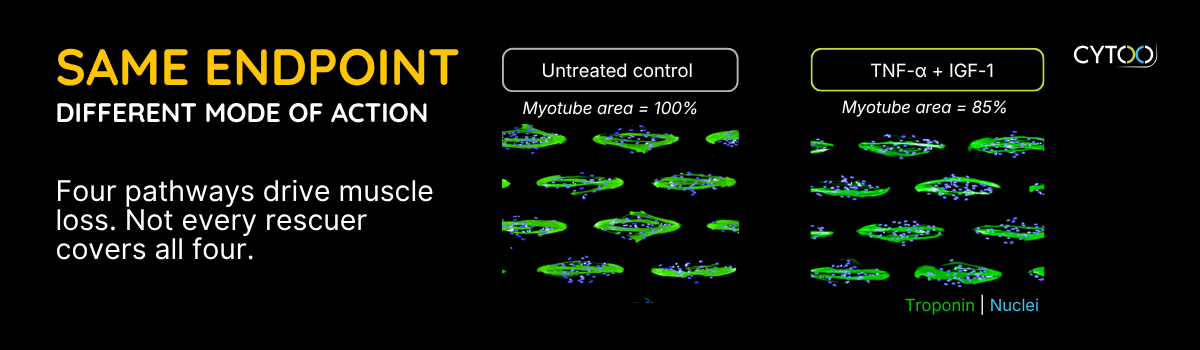
The preclinical implication is direct. Muscle formation involves two distinct and measurable processes: myoblast fusion and myotube growth. By combining fusion index and myotube area with metabolic and functional readouts, we capture the full picture of differentiation quality, on primary human cells from donors spanning a range of ages and biological sexes.
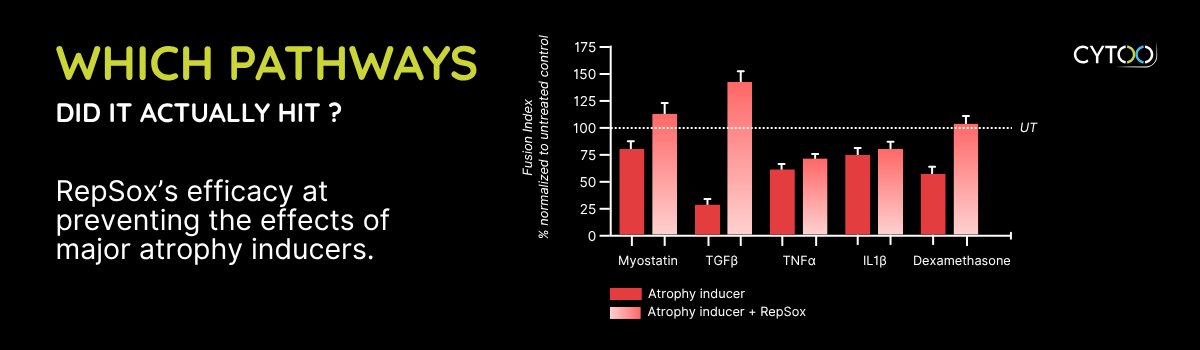
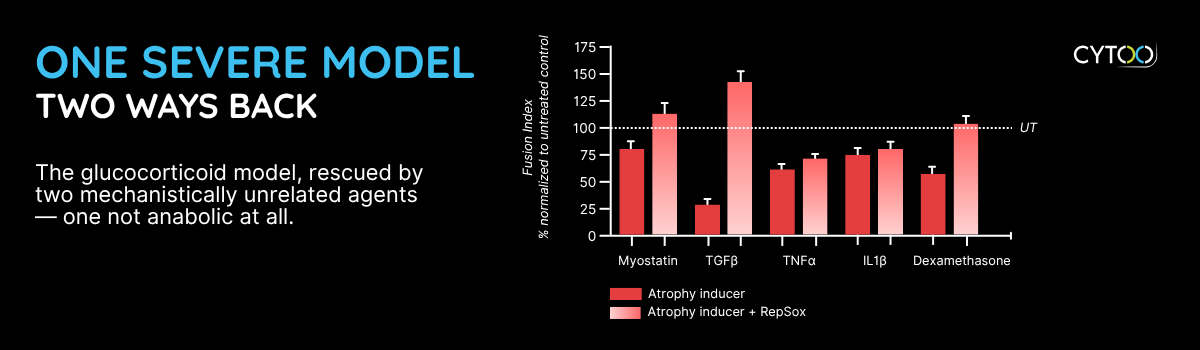
That is the same discipline behind the DMD potency assay we developed and validated with the FDA. In our panel, the glucocorticoid model is one of the most severe, and two mechanistically unrelated agents restore it. One of them is not anabolic at all.
Four posts, one table. The full inducer and rescuer matrix is here: